The night without darkness
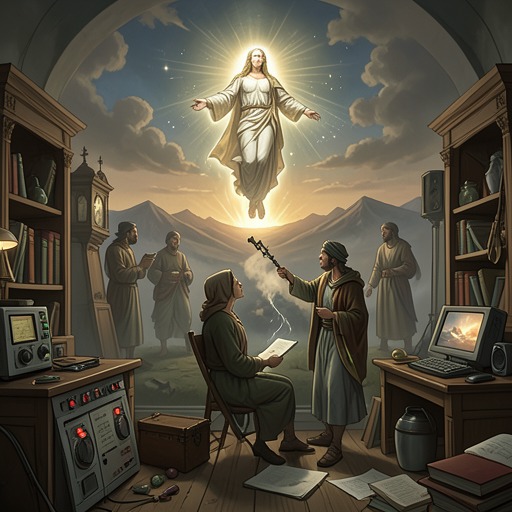
Book of MormonThe night without darkness is the sign of Jesus Christ’s birth witnessed by the Nephites in the ninety-first year of their history. Against a public deadline set by unbelievers, the promised darkness fails to come: sunset is followed by a night as bright as midday. The event confirms prophetic words, preserves the lives of believers, and declares that Jesus Christ has entered the world to show himself to all nations.
Prophecy and Crisis
The event occurs within the historical record of the Nephites, a people whose lineage is traced through Helaman, Alma, and Nephi to Lehi, who came out of Jerusalem in the first year of the reign of Zedekiah, king of Judah. The larger record presents itself as an abridgment written for the remnant of the house of Israel, as well as for Jew and Gentile, with the stated purpose of convincing them that Jesus Christ is the Christ, the Eternal God, manifesting himself to all nations. The night therefore belongs not only to local history but also to the record’s wider prophetic design. The immediate crisis is created by doubt. Some Nephites begin to say that the time has passed for the words spoken by Samuel the Lamanite to be fulfilled. The problem is not merely intellectual disagreement: unbelievers establish a day on which all who believe in the tradition are to be put to death unless the promised sign appears. Faith is thus placed under a political and lethal test. The approaching night becomes a boundary between prophetic fulfillment and the destruction of the faithful.
The Sign Appears
As the appointed time draws near, Nephi prays with deep anguish because of the wickedness of the people. In response, he hears the Lord announce that the time is at hand. The message tells him to lift up his head and be of good cheer, because the sign will be given that night and the Lord will come into the world on the following day. The revelation links the unusual darkness directly to the birth of Jesus Christ rather than treating it as an unexplained natural event. The words given to Nephi are fulfilled. At the going down of the sun, there is no darkness. Instead, the night remains light, and the people recognize that the sign has come. The record emphasizes the duration and completeness of the miracle: there is no darkness throughout the night, and the brightness is described as being like midday. When the sun rises in the morning, it does so according to its ordinary course, but the preceding night has already marked a decisive interruption in ordinary time.
Belief, Survival, and Reversal
The miracle reverses the value structure imposed by the unbelievers. Those who had been condemned because they trusted the prophecy are not killed; the sign appears before the threatened execution can take place. The believers’ apparent vulnerability becomes vindication, while the certainty of their opponents is exposed as false. A community facing death receives evidence that its faith has not been in vain. The event also converts prophecy from deferred language into public experience. Samuel the Lamanite’s words had been treated as expired, but the light of the night makes their fulfillment undeniable. The sign does not simply provide private reassurance to Nephi; it is witnessed across the land and becomes a shared historical fact. Its force lies in the contrast between what the people expect at sunset and what they actually encounter: the expected darkness is replaced by light, and threatened judgment gives way to survival.
Narrative and Theological Significance
The night without darkness functions as a concentrated sign of the Coming of Christ. It announces that the promised birth has entered human history while preserving the distinction between the sign and the person it signifies: the light belongs to the night before the Lord’s appearance, and the following day is identified as the time when he comes into the world. The event therefore joins cosmic alteration, prophetic speech, and historical chronology in a single sequence. Within the Book of Mormon’s larger narrative, the sign also establishes a recurring pattern in which divine power exposes the instability of unbelief and confirms the Lord’s covenants. The record states that its purpose is to show the house of Israel that they are not cast off forever and to testify that Jesus Christ manifests himself to all nations. The night’s universal brightness embodies that claim in narrative form: a local people receive a sign whose meaning reaches beyond their immediate crisis. The event’s deepest dramatic movement is from sealed expectation to visible fulfillment. The believers begin under accusation, facing death because the promised sign has not yet appeared; Nephi receives assurance through revelation; then the entire land becomes the setting for the sign itself. The light does not erase the prior threat, but it changes its meaning. The night that seemed to confirm the failure of prophecy becomes the very night in which prophecy is fulfilled, and the birth of Jesus Christ becomes inseparable from the deliverance of those who waited for it.